Showing posts with label South America. Show all posts

Saturday, February 28, 2009

Un Mensage para mis Amigos Hispanohablantes

EDIT FOR ANGLOPHONES: Sorry, I should have explained this when I first posted it. This is just a note for the people I've met in Latin America who've been reading my blog, thanking them and asking for a little help practicing my Spanish while I'm not in Spanish speaking countries.

Lamentablemente, no tengo bastante tiempo para traducir todo de lo que he escrito acá en Ingles a Castellano, pero sé que hay unos de ustedes que todavía están leyendo mi blog. Solo quiero decir que he disfrutado mis experiencias en el mundo hispanohablante mas que yo pudiera imaginar. La pequeña que he visto de la América Latina fue pura mágica. Y mientras la tierra y arte y todo que se puede ver es magnífico, la cosa más magnifico todavía es el gente. No tengo palabras para describir todo que he aprendido y visto de su cultura, cuentas, generosidad, y pasión. Muchísimas gracias para todo que ustedes me han mostrado y compartido.

Dos cosas. El primero es un sugerencia. Yo creo que todos de ustedes deben conocer un otra parte de sudamericana o centroamericana que no han visto. Hay tantos tesoros naturales y culturales distintas por todos lados en el mundo latino. En mi opinión es un necesidad conocerlos.

El segundo es un petición. He salido de el mundo hispanohablante para un buen rato-- pero no quiero perder mi español. Sé que es muy fácil olvidar un idioma cuando no se la usa. Si ustedes puedan escribirme para ayudarme mantener mi técnico con Castellano, le agradezca mucho. También, si tienes alguno sitios de web o otras cosas que puedo leer en mis viajes fuera del mundo hispanohablante, esta me ayudaría mucho también.

Una vez más, imuchas gracias a todos de ustedes, un abrazo para todos! Cuando vienen a los EEUU o otra parte del mundo, o de verdad cuando necesitan cualquier cosa, me escriban.

Wednesday, February 25, 2009

The Biggest Party in the World

I wasn't originally planning on doing this. I thought I´d be in Asia by now. I didn't think Brazil would be accessible, with the two weeks waiting for a visa and the hefty fee and everything that went with it. But that was before finding the consulate that can do visas in hours instead of days (Puerto Iguazu) and being invited over specifically to stay in Rio by some great friends, after meeting them in a certain episode involving stuffing my fleece in a speaker of a Bolivian bus.

And that's how I got to see this: a chunk of the Sambodromo-- the headline event of Carnaval in Rio de Janeiro. Where all the local samba schools come out and compete in the parade all other parades I had ever seen wish they could hope to be half of when they grew up. Ranks up ranks of singing, dancing costumes of amazing colors and huge feathers, wire, paint, and who knows what else pouring out of giant opening pyramids, spinning on moving forests with fairies, and floating by giant seahorses on Segways. But if you had come to Carnaval and only bought tickets and come to the Sambodromo, you'd have missed the point. The rest of the city had been itching for this party all year. The bloco street parades were all over the city, all day and all night for days and days leading up to the official start on Friday.

The blocos surprised me. Mostly what they consisted of was a group of drummers and a car with speakers, having someone singing what sounded to me like various Portuguese versions of "this is the song that never ends" and playing a ukulele. But they had hundreds upon thousands of people following them, wearing all the costumes you'd expect at a college costume party, singing along at the top of their lungs and packing the entire street for blocks upon blocks, dancing the fast-foot samba shuffle and inching their way forwards. People from all over the world came to this city to see it do what it does best.

The sights of the city itself are breathtaking. My guidebooks often try to spruce up the image of a city by describing it as "set spectacularly" among a surrounding of mountains and sea. But this place really is. There are green spires shooting up out of the ground at random intervals and ridiculous heights for their base size, opposite sandy beaches and blue seas with islands dotting the view. Just taking the highway up from the western neighborhoods downtown is a treat. A very very fast, slightly gut-wrenching treat, as the buses are the most reckless city buses I've ever seen, but a treat nonetheless.

The smells are not a highlight. Picture any of the parties you had back in college and how they smelled and what the apartment looked like the next morning. Now invite the 7+ million population of a major city, plus roughly 700,000 visitors, and have them go at that for about a month straight. There are admirable attempts to clean the place up each night, but that is one of the hardest cleanup jobs in the world. One of the smart moves was to pay people refunds for empty beer cans, leading to lots and lots of people running around with giant plastic bags picking up all the cans they can find. But don't touch the walls below waist level-- the men aren't keen on waiting in line for urinals.

Crime is also a bit of an issue. This is why I have relatively few pictures, I wanted to make sure my camera didn't get stolen (don't worry, there are a tone online, just search "Carnaval Rio 2009"). I emptied out my wallet of all cash and essentials just in case it was pickpocketed out of the zippered pocket of my shorts. Sure enough, it was. I lost my International Student ID and Hostelling International Membership card, plus a paper card that a friend of mine gave me in college, which I was sort of attached to. But then again, it led to what might be my favorite facebook status update: "Joel just lost his Get Out of Hell Free card in Rio de Janeiro during Carnaval."

Everything is no-holds barred. At first glance, you'll see the parties on the streets are filled with couples. They're not couples. The guy just grabbed the girl (or in some rare cases, the other way around) and now they are making out with more tongue than you've ever seen in your life. I was given strict instructions by my host in Rio: "If you see a girl you like, smile, and kiss her. No talking." (A word of warning for the single gentlemen at home who just got very excited-- the guys generally outnumber the girls at least three to one, and a good number of those are actually taken. Look for hand holding. Keep in mind who won't be taken already and why).

So, as you can tell, it's one of the most intense experiences you can find. Whatever you think about whether it's the best party you've ever been to, you can't deny that it's the biggest. If you are at all into samba, this will be the ultimate samba experience for you. Otherwise, just ask yourself if you like partying. If you do, you will love it out here. A huge Thank you to Antonio and co. for hosting me in Rio and showing me around your town. It wouldn't have worked without you-- once again let me know the next time you're on the road.

So, you might notice my latest location isn't Rio. I stayed up the last night through the sunrise, and then spent a collective sixteen hours on planes (including a 13 hour nonstop flight across the pacific from Buenos Aires) sleeping it off. I woke up in Auckland, New Zealand.

And that's how we're starting the adventures of continent number four: with a two-island nation slightly bigger than the UK, with 4.3 million citizens and an estimated 40 million sheep. Expect glowworm caves, Tasman beaches, mountains, forests, and maybe a shot at something I wouldn't advise you to try at home (not sure what yet, but after inventing the bungee jump, this is billed as the extreme sport capital of the world).

--
Check out this entry's Photos
.

Friday, February 20, 2009

"Some Very, Very Big Waterfalls"

This picture is kind of how I always figured heaven would look like. You're looking at the view facing the falls of Iguazu, just in front of the headliner waterfall El Garganta del Diablo-- The Throat of the Devil. It's a semicircular drop with water pouring down into white mist oblivion covered by rainbows.

Most waterfalls I've seen have been streams running off a ledge, maybe the occasional river running off a cliff. Iguazu looks like a sea running off a twisting, curving, canyon wall. Waterfall follows waterfall after waterfall all around you, surrounded by butterflies and rainbows. I'm not making this up. You half expect a unicorn to wander out of the subtropical rainforest instead of the spiders, coatil, and occasional monkey.

I was there on a very hot, very pretty day. At the hottest part of the day, I hopped onto a boat and decided to take a closer look. If I hadn't been warned a few minutes beforehand, I wouldn't have realized how just close a look it would be.

We pulled away from the dock, took pictures, video cameras rolling on all sides. Then we took a peek up to el Garganta, then back around to the other side. This is when I put my camera away in the provided waterproof sack. Also, after thinking a sec, my shoes and socks. We found one of the bigger waterfalls and started getting closer. And closer. Spray started flying everywhere. We didn't stop. White mist reared up twenty feet dead ahead. We didn't stop. We went straight into the waterfall.

Everything was white. Everything was very very loud. And everything was very, very, very wet. It was halfway between a shower and swimming in midair. On that 90+ degree day, that was exactly what I wanted.

The story for this post really is in the pictures. So, a shorter entry that normal this time, but that's because where I'm going next is my last stop in South America, and if lives up to its reputation, it's going to be the ultimate sendoff:

Carnival in Rio de Janeiro.

--
Check out this entry's Photos
.

Wednesday, February 18, 2009

Back to the Summer

That is Tango in the street. This is Buenos Aires. Get an idea of why I came back in such a hurry? I wasted no time in hopping a 3-day bus route back up the other way to the capital city, forgoing Argentine gems like El Califate and Puerto Madryn to get to Buenos Aires for a weekend. I'm sorry to miss everything I'm missing, but if I stayed in every country to explore as long as the country deserved, I'd still be in the first one I visited.

So that’s how I went from Antarctica to a city where it stays above 80 degrees at midnight. The kind of heat where you feel sweaty and gross, take a shower, and then feel exactly the same way about ten minutes later. So even while people online were IMing me to tell me how dumb I was to swim in Antarctic waters, I found myself wishing I could do it again.

Instead, I went to the neighborhood of San Telmo since it was closer. That’s how I found the San Telmo Sunday fair. And that’s where I took this photograph. Art everywhere, music everywhere, and the odd couple tangoing around the food salesmen, mimes, orange juice stands and the obligatory twenty-somethings with the cardboard signs that say “Free Hugs.” The crowds, acts, and sights shifted so much that I walked a two or three block radius for about two hours and hardly saw the same thing twice. I spent a chunk of my afternoon with a massive pumpkin, corn, and cheese pan relleno following drum bands, jumping ahead of them past the Charlie Chaplain impersonator to a three man jazz combo playing a block away from the four-accordion(bandolin), four-violin traditional tango orchestra with piano, cello and bass backup. This was after I'd gone past the didgeridoo (yes I had to look up how to spell it) and chatted up the local painter who had painted abstract portraits of her suburb based of of home video stills, adding things she felt were there but weren't in real life. Just like politics, she said when I told her my major in college, it's there in people's minds, but it's not really there.

Before that though, I had to fulfill a goal I’d been working on for longer than it should’ve taken me: seeing theater in Spanish. I quickly figured out that the equivalent of Broadway was Ave Corrientes, featuring a Spanish musical of Othello, Phantom of the Opera, and Pinter play, among others. I even saw a sign for Shakespeare’s famous “Mucho Ruido, Pocos Nueces,” which took me a second to actually identify since I couldn’t recall ever seeing a play called “Lots of Noise, Few Nuts” in the collected works (I had to switch “Lots of” to the more literal “Much” before I got Much Ado About Nothing out of that one). I was surprised to see how much of the stuff was originally English. I’d written off the preponderance of American movies in Latin America to the relative budgets and sheer numbers of movies the US puts out. But really the theater scene shouldn’t have surprised me that much. There are, after all, lots of plays that go up in the US all the time that are originally written in other languages. Just think of Checkov or Ibsen.

I found a small theater off the beaten track that was putting on El Duelo. It wasn’t until I got in the space and read the program that I realized it wasn’t originally Spanish either—it was an adapted version of Checkov’s one act, The Brute. Good too. The only time I had trouble with the Spanish was when both actors onstage were talking at once. Then I was even more lost than most of the people around me. Still had a great time, especially hearing the actors warm up from outside the house. That was what really brought it all back for me...

But I’m not done moving. I stayed in town long enough for the play, the fair, exploring some massive parks, making a few travel arrangements for the next two real big ticket items (details coming soon, I promise), and collecting on the offer of a private piano lesson from a professor I’d gotten into a debate with about politics and philosophy in Ushuaia. Now if only I had an easy way to practice the stuff on the road.

As for the bus out, I nabbed a discount through my HI membership and upgraded to “cama” or bed class for 5 pesos. Definitely worth it. Much comfier seats, full meals, wine included (airplane quality food of course) and I found one thing backpackers had been telling me about ever since Colombia: they give you a glass of champagne. Somehow I don’t see that happening on Greyhound back at home.

The bus has dropped me in Puerto Iguazu. Tomorrow I’m going on a boat trip through some waterfalls.

Some very, very big waterfalls.

--
Check out this entry's Photos
.

Sunday, February 1, 2009

A Week in the "End of the World"

Tierra del Fuego National Park-- Cerro Guanaco By the time I cross the tree line, I need a break. The sign behind me says I have climbed 614 meters. That means about 230 or so to go. But not until I have some water. So I turn around and take in the view of Ushuaia and the Beagle Channel, while sipping out of a leaky Nalgene imitation covered in plastic bags.

After a good rest, I get up and notice that there's another sign near the altitude one that has broken and fallen on its face. That's interesting. I lift it up, dust it off, and read: "Final de sendero señalizado." End of Marked trail. I look up at the steep slope of loose shale and moss. That's very interesting. There is an obvious choice here, one of the choices is sensible. Now which one do you think I picked?

Ten minutes later, almost to the top, I find an eagle hovering over the summit. I get envious-- lucky bird doesn't deal with sliding rock at 85 degree angles. But when I hit the summit marked by two sticks and massive gusts of wind, I felt I'd earned it.

Three hours later, I was sitting in the "microcine" underneath the city cultural center with the first piano I'd played in four months, learning tricks for playing tango music.

This has been my week.

There were two important things that happened in Ushuaia. First, I snagged a deal for an Antarctic cruise in such a way that by the end of it my travel agent was telling me all about her family, giving me tips on the best local trails, and offering me a free tent and sleeping bag to borrow ("They're my ex-husband's-- he's not gonna be using them in Costa Rica"). The second was finding a chunk of the local arts scene in a basement after following some outdated signs advertising tango lessons.

It started with music. There's a program in Ushuaia called "Hacelo Sonar," where people bring musical instruments and play them. The first time I came in and started playing piano, a boy about 8 years old came over just to watch. He refused to play until I finally got him hooked on a simple C-blues scale. One of the guys running the program came over, and between the two of us, we taught the kid basic blues progressions and a couple basic songs (including Heart and Soul-- may all those near him when there's a piano around forgive us).

Afterwards, I talked with the duo running the program for a while. And I do mean duo, Damien plays the Piano, Luisina plays guitar and sings. Together, they're Duo Huella sobre Huella-- they have some of their stuff online. They asked me if I'd heard typical Argentine music, then gave me a masterful private performance of sambas, tangos, and gatos. Haunting music, and I mean that in the very best way. The singing still goes through my head, along with the rhythmic tapping on the side of the guitar-- they use those whole instrument, not just the strings and frets. They taught me a couple basic rhythms and, as we walked out on the streets and they told me all about the town, they invited me to an advanced tango music session. It was kind of above my level, especially since in Spanish they teach music using Do Re Mi Fa etc. instead of C D E F etc.. But it did inspire me to grab the hostel guitar and spend some quality hours teaching myself how to play chords properly.

Then there were the other tango lessons, the ones that brought me to the little microcine in the first place. Dance lessons. I was a little surprised at the ages-- I'm guessing the girls' average age was about 16 and the guy's average age almost twice that-- but I learned a lot. Most impressive though was watching my teachers dance after our lesson. Argentine tango is legendary, and so different from anything I'd done or seen. It's all in the legs and the abrazo stance (literally "embrace"). The girl's forehead leaned against the guy's cheek, the girl seemingly losing balance against the guy until they turn, regain, and glide to the other side of the room. Everything is in the tension you feel between the two, like something just happened or is just about to happen, until with a flourish, it does, then back to the expectancy. It was privilege to watch that.

I've moved from my hostel to the hotel the the cruise company has put us in. In my room I found a offer for a free souvenir from HStern, and a list of services offered by the hotel's spa, including a "Sedative massage applied with chocolate and kelp cream" for about the price of three nights at my previous hostel. My immediate reaction was "where the hell am I and who stays here?" Later, I sat at one of the three free flat screen internet terminals. At the others, one very made-up fifty-something year old user asked the other, in English, what to do at the login screen of Windows XP, and the other looked over his bifocals and told her confidently "oh that's where you can do anything, search in Google there" (pointing at the text box for the password). Question answered.

The strangest part was when I was waiting to check in. An English-speaking couple in front of me asked where they could rent a car, and I after I helped translate a couple questions, the attendant told them that taking a taxi was better because walking outside was not safe. This is in Ushuaia. I was just told by Luisina and Damien that, six months ago, nobody locked their doors here. "Not safe"? Welcome to the tourist bubble.

Still, this is the bubble that's floating me across the Drake Passage, so I really shouldn't complain.

--
Check out this entry's Photos
.

Tuesday, January 27, 2009

A Long Way Down

Nice house in Ricoleta, Buenos Aires, ArgentinaArgentina is a change, and it's not just the (relative) wealth. For one thing, I’m back to being just above average height instead of being a giant among men who doesn’t fit in bus seats or doorways. There’s clearly much more European blood here. Argentina had massive waves of immigration from Europe, especially from Italy. They imported not just skin tone and stature, but also pizza, pasta, and ice cream. Also a bit of the accent, Argentinian Spanish doesn’t sound quite like its neighbors. The food is different- aside from the famous steaks and great Italian food, there seems to be a national obsession with hot dogs (known here as panchos) and these crust-less white-bread ham, cheese, and mayo sandwiches, often triple decked. Then of course there's the Alfajors-- glazed cookie sandwiches. Everywhere.

An Argentine day’s schedule takes its cues from Spain—it runs late. Dinner is usually around ten pm at the earliest, often as late as midnight. Don’t bother going out to bars or clubs before two am. Also, don’t expect anything to be open between noon and three in the afternoon, everybody has collapsed from being awake until five am and getting up again to start the day at nine.

Speaking of time, so you know though it isn’t marked as much on most maps, Buenos Aires is one hour ahead of the rest of the country, during summertime (December, January, and February on this side of the planet).

I'm taking the express route through the country. I've hit the border town of La Quaica, spent midnight hours in the streets of Jujuy, passed a day in Salta, then shot across and down to Buenos Aires in time for Obama’s inauguration (something I wanted to be somewhere with TV access for, instead of on a bus, even if, as a puzzled Brazilian friend of mine pointed out, I could’ve just youtubed it later).

Of all the cities I’ve been to so far, Buenos Aires gets the most hype. Usually when something gets that much hype, I actually lower my expectations. Chances of it living up to anything like how its described seem slim. But BA did not disappoint. I wouldn’t call anything with a lit-up 16-lane main drag (once again, named after my birthday!) the “Paris of South America,” but that isn’t a strike against the place. I understand why it gets the nickname. You wander past the numerous dusty bookstores, the parilla grills, the statues, cobbled streets, pizza shots, designer clothing stores, wide streets and skyscrapers both old and modern, and you, too will be trying to compare it to any and all of the modern cities you’ve ever seen in the “developed world.” Cross in front of the deep-dish pizza being served across the street from the theater featuring Phantom of the Opera and a Harold Pinter play on the secondary stage and it’s Chicago, or maybe New York (if you ignore the deep dish). Exit a Gothic church to find a helmet-less motorcyclist roll down the street listening to white iPod earbuds and smoking a cigarette and you could be, well, just about anywhere in Western Europe.

The whole place looks and feels like the 1st world but with this exotic edge to it. It’s not in the polish, it’s in the crust and dirt. It’s the things you find that are at odd, black angles, bits a pieces that remind you that you are still in Latin America, peeking out from the dark street corners at night. That’s another thing, from a theater perspective, this city has mastered light design. It knows what colors need to hit what spots and where the shadows need to be cast for best effect. It’s everywhere from public parks to little corner stores. Reminds you of all the little things tucked away in corners to find. Needless to say, I’m coming back to this town. There’s more here I want to see.

I’ve left for now. I got tickets straight down as far south as you can get direct from BA, then a little bit further. A double-decker bus marathon to Rio Gallegos and from there through Chile, across a ferry with black-and-white dolphins riding our waves and treeless hills dotted by sheep, llamas, and pink-flamingo filled lakes back across another border to the crags and forests of Tierra del Fuego province, Argentina. Also as a bonus, for the second part I sat next to a French guy my age who didn't know basically any English or Spanish but who had both a French-Spanish dictionary and phrasebook. So, I now know some very very very basic French. Enough to survive by in a French speaking country, I think. I hope. I'm looking through a "Francès para todos" to reinforce a few things while I'm here.

I called the part before that a "marathon," but “Gauntlet” might be better. I bought a $6 pocket radio with batteries and earbuds on my way out. When I stepped off the bus at a pit stop among my iPod and cell phone toting fellow passengers, I figured my cheap radio would be safe for a couple minutes unobserved. It wasn’t—it and someone else’s bag were reported missing shortly after we got back on. A couple hours later, our pirated, dubbed Stephen Seagal movie was interrupted by the announcement that the A/c had stopped working. In the Pampas and upper Patagonia in the summertime, this is a big problem. Three sweltering stops later, our bus had been replaced (though not after I’d searched it again for the radio and bag—finding a pillow and someone else’s jacket and bag). The second bus had two unexplained stops in a garage, then pulled over on the side of the road ten minutes out of town. I wandered up to the front of the upper deck, and took my time getting a cup of water. When we still weren’t moving, I went downstairs and asked the other passengers. They didn’t know what was going on either. So I poked my head into the driver’s compartment. Nobody there. I opened the passenger side door to the driver’s compartment and stuck my head out, finding both drivers looking at the back, who finally told me the engine had overheated. Half an hour later, we had pulled over a second time, and this time the main passenger door opened and everybody was told the bus was broken and we had to get off. We watched it get dark on the side of the road as a new bus took half the passengers on board and sped off. A second bus pulled over, then left. A third empty one pulled over and took the rest of us. I get a nice seat, and found out that the window is cracked and leaking. That’s about the time that I realized that my fleece had gone missing with my radio. I hadn’t seen it in the search that afternoon. We finally pulled into Rio Gallegos late, meaning I had to wait two more days to get a bus to Ushuaia.

As one woman in the first line on the first side of the first of two border crossings to Tierra del Fuego told me two days later, “Patience. When travelling Patagonia, you always need to bring your patience.”

I’m writing from Ushsuaia now, the self proclaimed “end of the world.” I’m spending a week here before a boat trip I booked. The views here in any direction, when not obstructed by a hotel or tourist shop, are magnificent. The hiking and camping opportunities are first class, and there are chances to see penguins, seals, and glaciers. Should be a good week.

And waiting at the end of it, that little boat trip I mentioned? It’s going to Antarctica.

--
Check out this entry's Photos
.

Sunday, January 18, 2009

Border Contrast

Salar de UyuniThat's not ice. That's a missive layer of salt, stretching in every direction. Same kind of salt you find in the ocean, the Great Salt Lake, or used liberally in almost all Bolivian food.

Still feeling a bit congested, I figured a three day jeep tour into a 5000 m high desert might do the trick to dry out the sinuses a bit. So I went to the Salar de Uyuni in a dilapidated Toyota 4Runner with two Argentinian politicians, a daughter of one of them, three other backpackers (two from Bavaria, one from Minnesota), and hard-of-hearing guide/driver/cook with a mangled right ear who stuffed fist-sized wads of coca leaves in his mouth to stay awake.

We weren't one of the lucky groups that got to see the Salar after it rains. It's a very flat surface which, after rain, turns into a gigantic mirror that you can walk and drive on. When dry, it looks like what you see to the left. Because of the flat white expanse, it turns into one of the world's best places for trick photography. Search around the web and you can find some great shots. Like this one. We even tried a hand at it ourselves, though the results were less than perfect given we had only five minutes at the time and our driver was honking his horn at us so we'd get back to the car.

Looking around, if you took the same artist god metaphor from a couple posts back, all you could think of is that he just decided he didn't like this massive piece of land and took a gigantic eraser to the thing, leaving flat white cracked nothingness in its wake, dotted with islands with some of the biggest and oldest cacti in the world (one purportedly more than 1,200 years old). Just plain bizarre.

After that, even the surrounding desert looked like it was lush and full of life, just from the scrub, occasional quinoa fields, and wandering llamas. We drove from rocks to flamingo filled oasis lakes, to more rocks, and saw bizarre mineral effects, like the Laguna Colorado, a lake that's a dirty pink color instead of blue in the middle, and surrounded by steaming geysers.

The geysers we got to visit up close on our way to bathing in thermal waters at dawn on the last day. It was freezing at night in the desert, but as Drew, the backpacker from Minnesota pointed out, all the two of us had to do was remember what it was like back in the Midwest right now and we would be right at home. Still didn't stop me from being impressed when my swimsuit, towel, and even my hair all froze a few minutes after getting out of the hot spring. But relaxing in steaming water a few yards away from white and pink flamingos dunking their heads to stay warm in the face of the sunrise isn't something I'm going to forget.

It was a long drive back to Uyuni that day, and the semi-functioning tape deck was blasting Bolivian cumbia all the way. Cumbia is a kind of music my guidebook describes as sounding like a "three legged horse." It's from Colombia originally, and I've tended to like the versions I've heard from there on North. But for some reason, the further south you go, it seems to deteriorate somehow, until you get the music made up of an old Casio keyboard, a singer who can't stay on key, a drum that's just slightly off rhythm and these random shout-outs like you'd hear in American rap music. I've gotten a little tired of it.

The trains out of town were full, so everyone was going on the rickety buses running on dirt roads to get south. I got on mine, found my seat to be the middle seat of the very back, at the end of the aisle. The seat ahead of me and to my right was taken by a mother and baby. Then, when the cumbia started blasting and window-rattling decibels, as it sometimes does on these buses, I realized that I was seated directly under the only speaker. I looked around me and found the other passengers reacting the same way I felt. So I calmly took off my fleece and stuffed it into the uncovered speaker (to cheers and claps on the back).

As we went along the road, I had leg room, I made faces at the baby to keep it amused and most importantly, not crying until it fell asleep. The road was rough enough that the rattling obliterated what you could still hear of the music through my fleece, and I spent the rest of the time chatting up my Brazillian and Argentinian row-mates in a mix of Portuguese-tinted-Spanish and English. If anything has made me feel like a veteran Latin America backpacker so far, that ride was it.

We crossed into Argentina. I think I'm in a whole different world. A day or two ago I was looking at this. Now I'm looking at this. Everything is bigger, cleaner, and nicer. I'll have much more on all the differences soon. I'm in the city of Salta and getting on an overnight bus to Buenos Aires soon. I took a little turn around town and noticed something on the map. A square with a date for a name. Pretty common here, often things are named after the dates of saints days. I walked into the tourist office and asked about it.

"Hey, I'm curious about this square, what's the date signify?"
"What?"
"The date-- it's my birthday. Is it also a saints' day?"
"Oh wow! No, that's Argentine independence day!"

...this country and I have the same birthday. I think this might be a good match for me.

--
Check out this entry's Photos
.

Health, Money, and Love, pt 2

"Cripes. Time. Right, skipping several important and amusing bits..."

I should have known that sentence would come back to haunt me. Now I have to remember all the stuff I was going to write. Funnily enough, I don't.

Mostly what I remember are images and culture differences. One of the images of course was just walking around the Inti Wari Yassi park and wondering where the jaguar was. Julio and I spent most of our time there without saying a word. It wasn't any awkward social circumstance, we'd just both agreed without even mentioning that we wanted to hear what was around us. Never did see or hear any cats, but what we did hear was pretty impressive anyway.

Speaking of cats, watching how the family treated pets was another experience. Four dogs, were occasionally tolerated in the house for a while, then shooed out with a large stick. The cat and kitten weren't shooed out, but their treatment was actually a bit more startling for me. Ever seen one of those new families in a park, the one where the dad is tossing the baby around in ways that make the baby squeal with glee and the mom squeal with shear terror? That's kind of how I felt about what they did with the kitten, only I'm not sure he was actually filled with glee either. There was a lot of squeezing, tossing and holding the poor little guy in ways I'm pretty sure he didn't appreciate. Funnily enough, I turned out to be the one person who could put him in his or her lap and have him stay there. Seemed scared of the others for some odd reason. No idea why. Really.

All it was though was a another way of showing what kind of a family they were: very tight knit, very loving. As Julio and I got up at 4am to go out to the rain forest, his parents insisted on going out with us and trying to give Julio all kinds of  dvice. They never said it, but they were clearly worried about their (twenty-one year old) little boy going out into the wild world without them. For the record, Julio gave them no real grounds for concern, he's very much capable of taking care of himself and others along with him. But that's the way things were.

I got invited to the youngest grandchild's baptism, (they insisted on having me be part of the family portrait). Afterwards, I fell into conversation with one of the cousins in her late 30s who told me she was still living with her parents. I said something about how I couldn't imagine doing something like that myself, unthinkingly adding something like "I needed my independence", and she explained that she too was independent-- it's just hard to leave her little sisters behind. They need help. So for that she stays with the family.

Sometimes that's just what's needed. I was there when Nico, the oldest grandkid, bought a pair of fish from the pet street market in town. A couple days later, I went up to the room of him and his mom to say hi and found him in tears. One of the fish had died. Within minutes, every female member of the family was in the room with him to comfort him and give him advice, talk to him about what they would do with the body, when and how they would get a new fish and what they would do to make sure it didn't happen again. There's a lot to value there.

I promised an explanation of the title of the post. Somebody visiting the house turned out to be one of those people who, when they sneeze, always sneeze three times. The usual polite response to a sneeze in Spanish is "salud". It means health. They told me in that in Cochabamba, when someone sneezes three times, they say that for the first sneeze, "dinero" (money) for the second sneeze, and "amor" (love) for the third. Some of them tended to tease me a bit for always only sneezing twice, saying it's a good thing because finding love on a trip like mine would "get in the way of things." But watching them all watch out for and worry about each other, it all seemed to fit in. It's the kind of family where the second grandson would take one look at you and without saying anything, walk over and sit in your lap. All the men hug, all the women kiss on the cheek. That's the kind of people they are. And they're there to wish you the best; health, money, and love.

And that's just when you sneeze.

--
Check out this entry's Photos
.

Tuesday, January 13, 2009

Health, Money, and Love, pt 1

(FAKE UPDATE, 1/18/09: I've decided to just make a part two for this entry instead of changing this one-- makes it easier for you subscribers out there)

I've got a lot less time than usual to write this entry-- trip to the Salar de Uyuni leaves in less than an hour and a half. Likely I will update this later when I have more time. Stay tuned.

I stepped off the bus at around 11:30 at night in Cochabamba expecting the usual friendly touts to meet us as we got off ushering us to their hotel/restaurant/bus. Sure enough I saw three guys standing outside and heard them yelling out names of the next big town west. First guy approaches me: "Santa Cruz?" I shake my head. Second guy: "Santa Cruz?" I ignore him. Third guy: "Joel?"

That was how I met Victor, patriarch of the family I had come to visit in Cochabamba. He and his wife, Rosy drove me to their house, rousted half their adult kids out of bed to say hi and stuff me full of as much food and drink as they could get their hands on. Before I went to bed at midnight, the youngest kids (fraternal twins my about my age) already had plans with me to go out the next night.

When I rolled out of bed the next morning, I came down fully dressed, but barefoot. The family was shocked. Not because of any taboo against bare feet but because they were sure I was going to catch a cold. Ten minutes later, I'd been handed a pair of nice sandals that were (almost) my size. Once again stuffed full of food, I was warned vigorously against the ills of the climate-- if I was out in the "cold" (roughly 60 degrees F by my guess) without warm clothing, I was sure to get sick. Same with the rain, same with walking barefoot on their tile floors, it would be sure to do me in. Coming from much colder cities with much more rain, I assured them that I was going to be just fine. I always thought the whole cold-bringing-on-illness thing was a dumb superstition anyway. Viruses and bacteria make you sick, not air temperature. As we were making the empanadas pictured above, I assured them that I didn't feel cold in the least and that, coming from Seattle then Chicago, I didn't think I was likely to go and get sick.

Sure enough, I went and got sick. I think it was the flu. Cold symptoms plus mild fever and general weakness. When a local doctor at a pharmacy examined me, she said that I should "hurt all over", and tried putting me on antibiotics. I pointed out that I already had some in the form of anti-malarials, so she relented with some anti-flu combos.

If you ever get sick abroad, get sick while you're staying with a family. I had to fend off so many offers of tea, medicine, entertainment, and general care that it started getting silly. Part of it is that the family also just happened to be a big family of fantastic hosts. In the three-story house were the parents, the oldest daughter, Judy, and her 8-year old son, Nico, the oldest son (named after his father of course), and the youngest son and daughter (fraternal twins), Julio and Mary, space for the middle daughter to visit with her husband and two sons, the apparent servant who came six days a week, four dogs, and two cats. Plus me. The house was the classic echoing Latin dream place: big open rooms, white (marble?) tiled floors, and white walls liberally sprinkled with pictures of Jesus, Mary, and a few selected saints.

Aside from generally being a lot of fun to hang around, the family was exceptionally generous, and I don't juist mean the mountains of food I had to fend off. By the time I finally left (after they convinced me not once or twice but three times to extend my stay), they had given me an artisan leather wallet, a handcrafted messenger bag, two key chains with hand painted miniature traditional flutes, a special eucalyptus balm for apparently everything, and a hand-woven traditional belt. On my way out the door they tried to get me to take the sandals as well until I finally convinced them that, while I was very grateful, I just didn't have any room left.

I already sent home half of what they gave me. I'm hanging onto the bag as a replacement for the part of my pack that got stolen, and the wallet's a great replacement for my old duct-tape model which was falling apart at the seams anyway.

Cripes. Time. Right, skipping several important and amusing bits, halfway through my stay, I medicated myself up enough to take a trip into the Amazon. I had my eye set on a particular nature reserve, but just before setting out, we found that a landslide had taken out the road there. But I chatted with Julio and we decided that wasn't going to stop us. We got a bus to the landslide, crossed it, walked a bit further, and a got transport the rest of the way.

So much green. Everything was green, everything was snared or connected to something else somehow. I have a good friend who looks at these things, smiles, shakes her head and says "God is an Artist." If that's how you look at the world, then when God made the Amazon, he just took a green pencil and never lifted it from the brown-red page. No cat sightings unfortunately, but we did see a ton of monkeys, including one that specifically guided me up the path a ways (I have pictures), a turtle, and massive parrots. Plus I got to cross a swinging rope bridge in the jungle to get to a waterfall. If my day hadn't been made already several times, that would have done it.

Anyway, much much later, I've left Cochabamba and am now in Uyuni, looking at a tour that will take me through the Salt flats and on to Chile. Leaves in minutes. I'll update this entry later to at the very least explain the title and what it has to do with sneezing three times. Right, for now, gotta dash!

--
Check out this entry's Photos.

Thursday, January 1, 2009

Machu Picchu

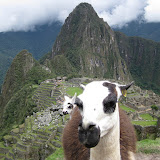
Llamas on Machu PicchuI'm not usually the type to buy Christmas presents for myself. I made an exception this year.

This picture was taken from just below the "guard house" in Machu Picchu. I took it after getting myself soaked and filthy by mountain biking downhill across rock slides and rivers and then trekking three days across Inca trails carved straight into the side of a cliff face. It ended with an hour's trek just before dawn straight up the side of a mountain to gain entrance to the Incas' most famous ruin in one of the most spectacular settings in the world.

When we first started, I looked around at the mountains and forest and thought that this was all kind of familiar, like hikes I'd done at home. But after a steep uphill climb that brought us out to the side of the Sacred Valley I realized this was like nothing I'd done before. Everything but the path was vertical. If the spectacular views of the mountains and river didn't make you dizzy, vertigo would instead. Just try going up and down the steep craggy stairs. I'd handled much more steep and rickety stairs back in the Mayan ruins, but the sheer drop hundreds of feet to one side was like having someone very large breathing down your neck hissing "don't mess up, don't mess up, don't mess up" into your ear the whole way through. Absolutely worth every step though.

I can't pretend it was all hardcore rough and tumble adventuring. Yes, we had plenty of that, but the most challenging thing for a couple of my Australian friends in our group was being told by a security guard that they couldn't drink their beer in the hot springs they were relaxing in. Against the rules apparently. Also challenging was trying to convince our guide that, no, we weren't going to spend all night in the tourist discotec, because we were going to sip rum and coke with the locals in front of a tienda, while some of us played soccer with kids on the street instead. Though somehow we ended the night by astonishing everyone else in the club by showing up later, making complete fools of ourselves with a chair, a pole, and several dance offs, and then conga lining out of the place. Funny how that goes.

Machu Picchu was great for fantastic views and ruins of incredible size. But it was also great for people watching. I was the first in my group to the top, around 5:45am. There were maybe fifteen others milling around. Within less than 45 minutes, a line of more than a hundred was standing outside the entrance pouring in from the stairs and the buses that had started to arrive. More than half seemed to be either American or Japanese. When I took that photo up there with the alpacas, I was surrounded by a mob of at least fifty vying for the same shot. Hundreds and hundreds of people of all ages were pouring in, from babies to people using walkers. It was big enough not to feel crowded even though at least 500 people were on the site at any given time.

One thing that struck a personal chord for me when I was walking around the ruins comes from my grandfather. When he was in the US Army in WWII, he looked around in Germany and made a simple observation. The houses and buildings made of stone still stood where others made of other materials had fallen. Some of these houses were quite old. So, when he came home to eastern Washington State, he decided he was going to build himself a stone house. They lasted longer. So, over the next few years, he did it. Looking closely at some of the structures on Machu Picchu, most of them were made in kind of a similar way to my grandpa's house. That's more than 500 years through storms and earthquakes. Perhaps my Grandpa's house will last a bit longer than he originally realized.

As usual, this whole account is a few days behind where I actually am. I'm sitting in La Paz, Bolivia surrounded by slightly hung over travelers unforgivingly awake again after new years eve. I realize I haven't really updated in detail what I've been doing since the Galapagos. The quick summary runs as follows: I spent some time in the Ecuadoran mountain town of Otavalo, including a haunting nighttime solo hike to my farm stay hostel through thick fog my flashlight could barely handle. I then booked it down the coast of Peru, stopping long enough to have some amazing ceviche and chat up some Lima natives before heading up to Cuzco. After Christmas and my trek, I moved on to Bolivia, stopped by Copacabana and lake Titicaca, and then headed to La Paz to ring in 2009. Next on the agenda, with any luck should include a visit to some family friends, my first real foray into the Amazon rain forest, and a trip to see something called the Salt Flats of Uyuni. If only I could start every year this way...

Happy New Year, everybody!

--
Check out this entry's Photos
.

Thursday, December 25, 2008

Merry Christmas

As far as I'm concerned, it's not Christmas unless I get to play with kids. This year, it was a crowd, mostly orphans, from a local school here in Cuzco, Peru. We got Santa out to the courtyard to give them gifts, and then Peruvian Christmas fruitcake and homemade hot chocolate made with cinnamon, condensed milk, and cloves.

It's late, or early depending on how you look at it. Been out too late with fireworks and clubbing. As I write this, the sun is rising behind me over the town. The city lights crawl up the hills, spreading from the plaza de armas and cathedral in the middle, up to my hostel.

I can update you with details of what I've been doing later. More importantly, I just wanted to wish everybody happy holidays from down here. Spend them with someone you love. If you can't do that, spend them doing something you'll never forget.

One thing I've been thinking about a bit lately is an old black and white comedy sketch about Christmas, either WC Fields or Red Skelton, I forget which. The main character is a homeless man who is determined to spend Christmas in the warmest, most hospitable place he can get to for the holidays: the county jail. So he tries robbing someone, eating dinner without paying, and committing other various crimes, hoping to get arrested, but every time the cops come, they look at him and say "Aw shucks, it's Christmas. Let the poor guy go."

There's nothing quite in the spirit of Christmas as much as the act of giving. Sometimes what people want isn't the obvious thing. I'm not trying to say you should get your friends and family thrown in the clink. But now is a time to figure out what it is someone truly wants and give it to them. You just might be in a for a surprise.

Happy Holidays from Peru, everyone.

--
Check out this entry's Photos
.

Friday, December 19, 2008

Galapagos

Galapagos ThreesomeI just got back from a 16-person cruise in the Galapagos Islands.

For those of you whose jaws did not drop at that sentence, let me explain. The Galapagos Islands are a set of islands under Ecuadoran jurisdiction, right along the equator, directly south of Guatemala. The first human uses of this place were as a headquarters and hangout for pirates cruising the Pacific side of the Spanish main, but the voyage that really put it on the map was that of a ship named The Beagle. Aboard this ship, as mandated at the time, was a naturalist. The Beagle's naturalist was a fellow by the name of Charles Darwin. What he saw then and what we still see today revolutionized the way we look at biology. He found a pattern of animals, clearly from the same ancestors, but who had each adapted to the islands they were living on, to the point where they were their own distinct species. For example, Tortoises that had tons of food lying around had huge shells that kept their heads low to the ground. Tortoises with little food in their environment had big spaces up above the neck so that the head could stretch up and snag the last low-hanging leaves and cacti. Finches' beaks varied in length, width and sharpness depending on what would be best for getting which kind of food on their island. It wasn't that much later that Darwin went public with his theory of Evolution.

Today the islands, aside from being idyllic Pacific islands, are now the embodiment of Wildlife Watching for Dummies. It's what you always imagined going out into nature to see wild animals should be like. It's easy, you see something new every five paces. There are unique species of fish, lizards, birds, and much more running around everywhere, and they don't fear humans. They aren't tame exactly, they don't come running up to people for handouts, but they don't run away from people either. If you walk towards most wild animals in other places, they will either flee, or start making threats. In the Galapagos, I walked right at tiny little finches and lava lizards who would simply hop out of the way, then cock their head sideways at me as if to say "where are you going, mister?" A giant tortoise and a large land iguana in turn walked directly my way with no intent on stopping if I didn't budge from their path. At least three young sea lions flopped their way to sniff my legs, just to make absolutely sure that I was not, in fact, their mommy.

I should say that this place is not a where you find wild expanses of jungle. Most of the landscape actually looks like desert, especially now in the dry season. Cacti are everywhere and there's a lot of cracked dry land and scrub (though the water is a breathtaking shade of blue that I didn't think existed outside of photoshopped beach pics). There are essentially seven different biomes across the island depending on elevation and the direction they face (the prevailing winds bringing different things to different sides of the various volcanoes). But most of what I saw was dry scrub, covered in sea lions, crabs, iguanas, and a huge range of unique birds with hilarious names, such as my favorite, the Wandering Tattler, and everyone else's favorite, the Blue Footed Boobie.

I took hundreds of pictures, and while being very very conservative (though still putting up more sea lion pics than I'd meant to) I've almost maxed out my monthly allotment on Flickr. If my set isn't enough for you, check out my friend Laurence and his family's site for more shots from our group's trip.

The one thing I couldn't get any pictures of was the underwater life. I couldn't go diving because of a slight cold (makes equalizing underwater pressure difficult and potentially dangerous) but I did get to go snorkeling at least. Even the simple list of what I swam with seems incredible. Aside from all the almost luminescent schools of purple, red, and rainbow colored fish swimming around coral, anemones, sea cucumbers, and sea stars, I had sea lions swimming laps around me like gigantic otters, startled a rockfish out of its camouflaged spot, saw a few stingrays float below, a pair of sea turtles bump into me after they were swept off by a an unexpected current, watched a blue footed boobie dive underwater about six feet away to snag a fish snack, floated over a few semi-covered little flounders with both eyes on one side of their bodies, and, at one tense moment, turned around to find a white-tipped shark snaking it's way through the water about ten feet away (I know they're mostly harmless to humans, but that's still a lot of very sharp teeth).

And we saw it all in style. I snagged a very last minute deal aboard the 16 person catamaran, Millennium, with rooms I'd expect from a four star hotel, three gourmet meals a day, small library and game set in the main lounge, and an observation deck up top (saw a ton of shooting stars). We had an official level III guide (trained biologist, lots of experience, speaks at least four languages) who led us across two islands a day. This was one of the two splurges I've planned for this trip, and I'm very glad I indulged.

Now I've come back to the rough and tumble life of the backpacker, currently stationed in Otavalo, Ecuador, and eyeing my next country. Also figuring out where I want to be for Christmas... My first one away from home and family.

In the meantime, I've been shown around some of the gorgeous waterfalls by the grandkids of a shaman I met on the bus from Colombia, and in a few minutes will be stepping out into what I heard at least one person call the biggest market in South America. So far I'd have a hard time finding streets in this town without some kind of stalls on them. Should be a good day, I think.

--
Check out this entry's Photos
.

Saturday, December 13, 2008

Colombian Lights

Festival of Lights, Villa de Leyva, ColombiaI got off the bus in the mountain town of Villa de Leyva expecting a quiet colonial village with few people. Instead I found a bustling colonial town with almost every single hotel entirely booked through the weekend. The reason? The Festival of Lights. Every year what seems like half the country pours into this little whitewashed town with seemingly no buildings younger than 400 years old, packs into the main plaza, sets off tons of fireworks and then parties until four in the morning. I'm not sure if I've ever seen so many people drinking and yelling and singing in one spot as I saw that town square. You could've easily crowd-surfed the wads of people packed in the stores buying beer and aguardiente (local firewater made from sugarcane and anise).

Aside from seeing some great fireworks being exploding so close that they set off multiple car alarms, I think my favorite part might have been one of the more ironic ones for something celebrating light. About half an hour after the last fireworks ended and the first musical act started, the power went out. All the sound systems, Christmas lights and buildings lost electricity. At first everybody laughed and cheered. Then something interesting happened. Instead of getting rowdy and complaining, I started hearing snatches of music here and there. In every corner, people were breaking out drums, sticks, guitars, and making their own circles and singing their heads off. Candles came out of nowhere, some tourists blinded all their friends with their headlamps they had "just in case," and the party went right on. We got power back about twenty minutes later, lost it again after a few seconds, then got it back even later.

I left during the second day to go to Bogota, but even there there were celebrations. The national park was absolutely packed, and my taxi driver and I ended up stopping on the main street just to watch the fireworks go off above our heads. The festival wasn't confined to the big public areas either. As we drove by the smaller streets we saw people with maybe fifty candles sitting outside their homes, chatting, enjoying each others company.

The next day, just about everything had been shut down. I spent the day checking out the sights and getting a few errands done. My poor, ailing camera finally turned in its letter of resignation in the form of multiple repeated memory card corruption errors. So after talking with my family some, I picked up a new one.

If you've ever had a new camera, especially a new digital camera, you'll know the effect it has on your eyes and brain. Everything and its mother looks photogenic. Everything. And that's if you're just sitting at home. Now imagine that same effect, only you're in the gorgeous colonial capital city of a foreign country bordered by a mountain range you can take a cable car up to the top of for the view. I had to forcibly restrain myself from only looking at where I was going through the camera screen. I have some of the most random pictures of dogs, graffiti, trees, streets, gold museum exhibits, guinea pigs (which is another story in and of itself), you name it. And at they time, they all looked absolutely fantastic. We'll see what I think of them in about a month.

I made my way south to Cali, the mecca of Salsa dancing, and found another cultural experience I wasn't expecting. The towns two major football/soccer teams were playing each other and that if the one with home team advantage won, it would go onto to finals. So I hopped a bus and got a first floor ticket. Being a typical Yankee, I'd never been to a professional soccer match before, and I figured if there was anywhere to start, it would be in South America. I made sure I was wearing neutral colors, got a bite to eat, and grabbed my earplugs as an afterthought before catching a city bus to the stadium. I figured if things got just way too loud after a while, I could put them in.

That "after a while" turned out to be roughly two minutes and 30 seconds after entering the stadium. This was not the polite, quiet Seattle Mariners Baseball crowd I was used to. Maybe the companies of mounted and riot police stationed outside the entrances should've tipped me off. I was surrounded by a throbbing, screaming, singing, and jeering red mass supporting Cali America. The fans behind the goals not only never sat down, they never stopped jumping up and down for the entire match. I saw at least one person try to climb the barbed wire fence to yell at his favorite players. That atmosphere alone was well worth the price of my ticket.

One of the funnier things for a foreigner was the sounds of a non English speaking crowd. For example when something goes wrong for an English speaking crowd, you hear everybody go "Awww..." in unison, and maybe boo. Here, everybody made this "aaOOgh" sound that, for me at least, was a bit like the bark of a great dane. Also instead of booing, ape sounds and gorilla arms seem to be the norm for making fun of someone or showing disapproval. And the songs they sang... I would not have translated those in front of English speaking kids the age of some of the younger fans there. Wow.

Cali America won 1-0, qualifying for the finals, and the fans did not the let the city forget it for the entire night. All across town was a sea of honking, cheering, and singing red. Meant I saw a lot more drunk soccer fans than salsa dancers, but I still had a lot of fun.

That was all a few days ago. I'm in Ecuador now. Quito, to be specific. I had a breathtaking ride through the southern mountains (just look at that) and then an excruciatingly long border crossing. Imagine standing in a shortish line, say twenty yards or maybe less. Now imagine standing in that line for over four hours. That was Ecuadoran migration. But after that, sleeping on a parked bus to avoid bringing all my stuff through a dangerous neighborhood at midnight, and I'm here, enjoying parades, parks, and the scenery. Also I'm shopping for shoes. A short but overgrown and challenging hike ripped apart my hiking shoes, and after a repair job lasted only three days I ditched them in Cali, relying on my sandals instead. Turns out to have been a bit of a mistake. I wear size 13 mens shoes. I'm about half a foot taller than most latin american men, and it turns out nobody here sells shoes my size. I'm having a hard enough time just finding shoes two sizes too small. But any chill from walking around a high mountain town in Teva's is easily eclipsed by my shopping for...

...well, actually I'm not going to say what I was shopping for quite yet. I found it, at around 45% of its original price, but my head is still spinning just thinking about how much money I just spent. And that's after plunking down the cash for a new digital camera. But this...

Let's just say my next post should be a good one.

--
Check out this entry's Photos
.

Thursday, December 4, 2008

From the Ground on Upwards

Look closely at those leaves. They're being carried by ants. This whole path, with no grass, has been eaten and worn away by these ants. If you click on the picture you can get a closer look.

I've seen these ants in every park or forest I've been to from Mexico on south, and they still kind of amaze me. There's always just this little highway of moving bits of leaves crossing my path.

This time it was in Panama city's Parque Metropolitano, a national park within the city limits of the nation's capital. It´s five minutes walk from a huge mall, bus station and domestic airport. I went from shopping in a department store for a fake Nalgene to using it for a three hour hike without needing to sit down once in between.

Surprisingly the park seems pretty tranquil. You can hear the cars go by when you´re near the entrance, but I saw a ton of birds, lizards, turtles, and even six White Nosed Coati. And of course the ants.

It was sort of the last thing I had planned in Central America. The next day, a couple friends of mine and I went to the airport for our 11:00 flight to Cartagena.

The buses took longer than we expected, so we arrived at the flight counter a bit later than expected. We asked for our tickets. They refused to give them to us. They said they were supposed to stop giving out tickets at 10:00. I looked up at the clock. It was 10:06.

I argued it, went to other airlines, tried the airline office, but no luck. Even if the flying time was less than one hour, it was an international flight, and despite not saying this anywhere on their website, our ticket, our confirmation email, or the airport's website, we were supposed to know to be there exactly an hour in advance. We couldn't budge them on this. We missed the flight.

Fortunately there was another flight. At 9 pm. We changed tickets and spent the next nine hours upstairs in a hyper-air-conditioned cafeteria, talking eating, playing cards, watching the Simpsons in Spanish, playing cards, sleeping, staring at the walls, and I think, maybe... yeah, playing cards.

We finally got our boarding passes, through security, wandered around duty free a while, and then boarded our plane. By which me mean boarding a bus which took all ten or so passengers to a Dash 8, a twin-engine, turboprop plane with nine rows of seats. By far the smallest thing I'd ever flown on in my life.

And it was so much fun.

I was not expecting that at all, but I'm used to jets where you sit in an apparently immobile metal tube that suffers an earthquake every few minutes. I'm not a big fan of turbulence and expected to have a lot more of it in this little thing. But it was just a different experience entirely. It was really flying. Yes there were bumps but you could really feel the wind behind them. Looking out the window an seeing the propellers roaring over the shrinking ground was a real trip. It was the old-fashioned kind of travel, the kind you picture on all those vintage posters when you think travel. It probably changed how I look at planes for the rest of my life.

So I'm in South America now. Even since before we touched down, I've been feeling good about this leg. It's as if Central America was just the warm up for this. I'm in the walled city of Cartagena, Colombia. I've been exploring the biggest Spanish fortress in the Americas, with a flashlight, creeping through underground tunnels filled with puddles (impressive acoustics-- if you sing the right note down there you can see the sound waves ripple on the water). I've also been browsing the Naval History Museum of the Caribbean, mostly focused on how many times the poor city has been sacked by so many people despite how intricate and massive the defenses were.

Later I ended up invited to and registered at a conference on combating Hunger and Poverty (Babelfish Translation), with groups like Accion Social, the World Food Program, and the UN in attendance, along with the governor, several local NGOs, and interestingly enough, the national petroleum company present (the petroleum company was showcasing how it was using its profits for environmental and social justice campaigns). All the people I talked to at the conference were hopeful and excited about what they were doing, especially in terms of helping impoverished families become self-sufficient and more prosperous. Everybody was talking about how much success they'd seen recently and how much more they were going to have. It was great getting to meet all these people working to make other people's lives better. Plus there was free food. I like free food.

Ending post bad news (I really hope this doesn't become a tradition) my camera's condition continues to worsen. Now any photos I take have a blurry lower third with the colors screwed up. I've posted a couple passable ones, but I'm starting to get worried. The vast majority of my shots in Colombia so far simply didn't come out, which I´m kinda bummed out about. Especially when it comes to the sunset shots over the Caribbean I took from the city's 400 year old walls...

I'm heading south today, up to the mountains. After being cooped up on an island and then wandering in Panama city looking for a way onward, It feels very good to be somewhere that I can leave just by hopping on a bus.

--
Check out this entry's Photos
.